Research

Rhombohedral graphite nanoelectronic device

Cryogenic Shock Exfoliation for Ultrahigh Mobility Rhombohedral Graphite Nanoelectronics

Ludwig Holleis, Youngjoon Choi, Canxun Zhang, Jack H. Farrell, Gabriel Bargas, Audrey Hsu, Zexing Chen, Ian Sackin, Wenjie Zhou, Yi Guo, Thibault Charpentier, Yifan Jiang, Benjamin A. Foutty, Aidan Keough, Martin E. Huber, Takashi Taniguchi, Kenji Watanabe, Andrew Lucas, Andrea F. Young

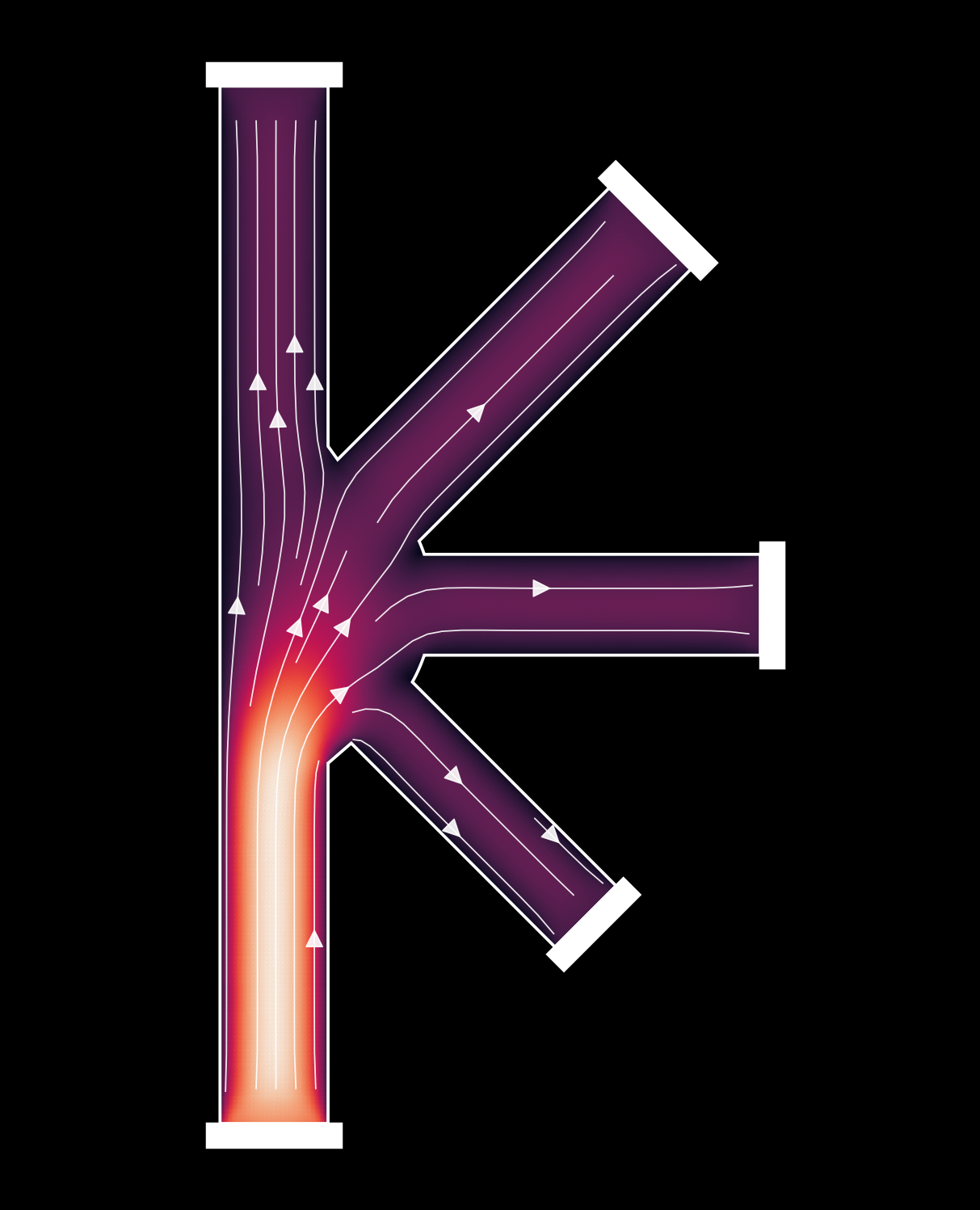
Our experimental collaborators developed a technique for fabricating very large, ultraclean devices of 13-layer rhombohedral graphite. This unusually thick rhombohedral system hosts flat surface bands in a device large and clean enough for electrons to travel hundreds of microns, making it an exceptional platform for studying interaction-dominated electronic flow. We contributed kinetic simulations of the electrons that demonstrate the purity of the devices and reveal especially clear signatures of electron hydrodynamics.

Paper

Electron hydrodynamics in flat-band bilayer graphene

Imaging Electron Hydrodynamics in Flat-Band Bilayer Graphene

Canxun Zhang, Evgeny Redekop, Hari Stoyanov, Jack H. Farrell, Sunghoon Kim, Ludwig Holleis, David Gong, Aidan Keough, Youngjoon Choi, Takashi Taniguchi, Kenji Watanabe, Martin E. Huber, Ania C. Bleszynski Jayich, Andrew Lucas, Andrea F. Young

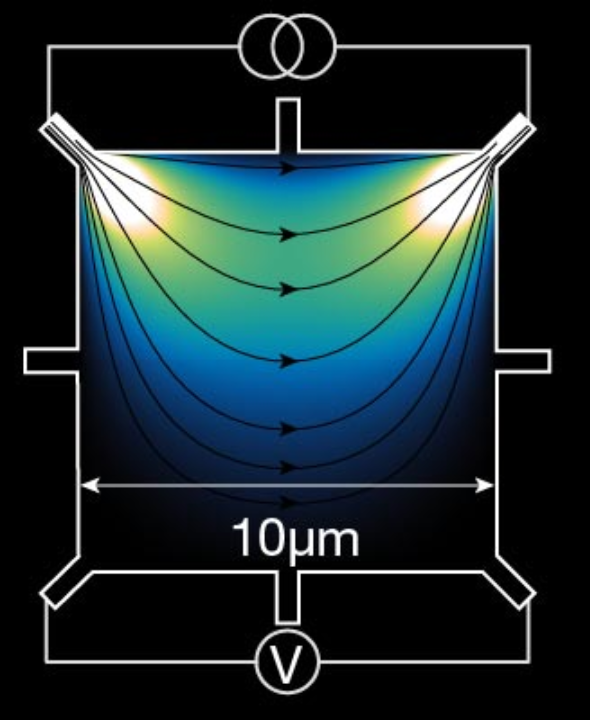
Our experimental collaborators used state-of-the-art scanning magnetic imaging to directly identify ballistic, hydrodynamic, and diffusive transport in dual-gated bilayer graphene across the full phase diagram. In the flat-band regime, I contributed a linear Boltzmann transport model that fits the data and extracts an electron-electron scattering length comparable to the Fermi wavelength (~50 nm), giving a sharp signature of hydrodynamic behaviour in an exquisitely controlled device.

Paper

Supersonic flow in electronic de Laval nozzle

Supersonic Flow and Hydraulic Jump in an Electronic de Laval Nozzle

Johannes Geurs, Tatiana A. Webb, Yinjie Guo, Itai Keren, Jack H. Farrell, Jikai Xu, Kenji Watanabe, Takashi Taniguchi, et al.

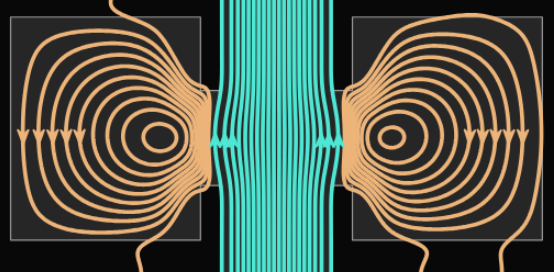
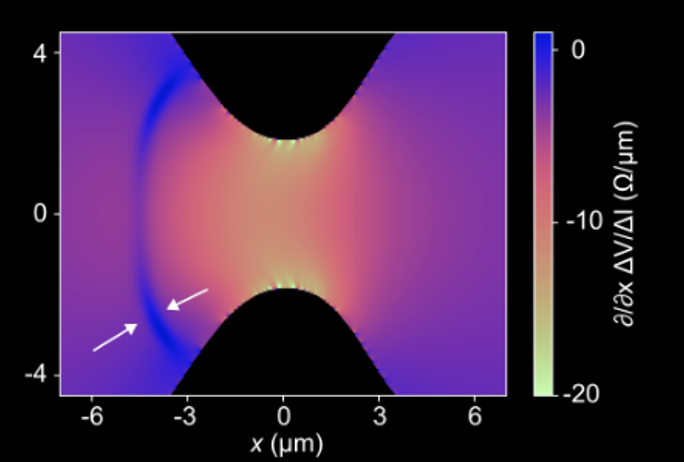
Our experimental collaborators engineered a nanoscale electronic de Laval nozzle that pushes electrons in bilayer graphene past the electronic speed of sound, producing a viscous shock front. Their transport and local potential measurements give a striking window into compressible, intrinsically nonlinear electron flow. We helped connect these measurements to hydrodynamic theory, showing how electronic fluids can realize supersonic flow, shock formation, and hydraulic jumps in a highly tunable solid-state device.

Paper

Generalized time-reversal symmetry

Generalized Time-Reversal Symmetry and Effective Theories for Nonequilibrium Matter

Xiaoyang Huang, Jack H. Farrell, Aaron J. Friedman, Isabella Zane, Paolo Glorioso, Andrew Lucas

We build a systematic effective theory for driven and active matter by identifying the right generalisation of time-reversal symmetry out of equilibrium. The framework reproduces and extends the fluctuation-dissipation theorem and gives a unified language for nonreciprocal dynamics, driven rigid bodies, and active chiral fluids. This makes it possible to constrain noisy nonequilibrium theories with symmetry principles even when ordinary microscopic reversibility is absent.

Paper

Hydrodynamics with helical symmetry

Hydrodynamics with Helical Symmetry

Jack H. Farrell, Xiaoyang Huang, Andrew Lucas

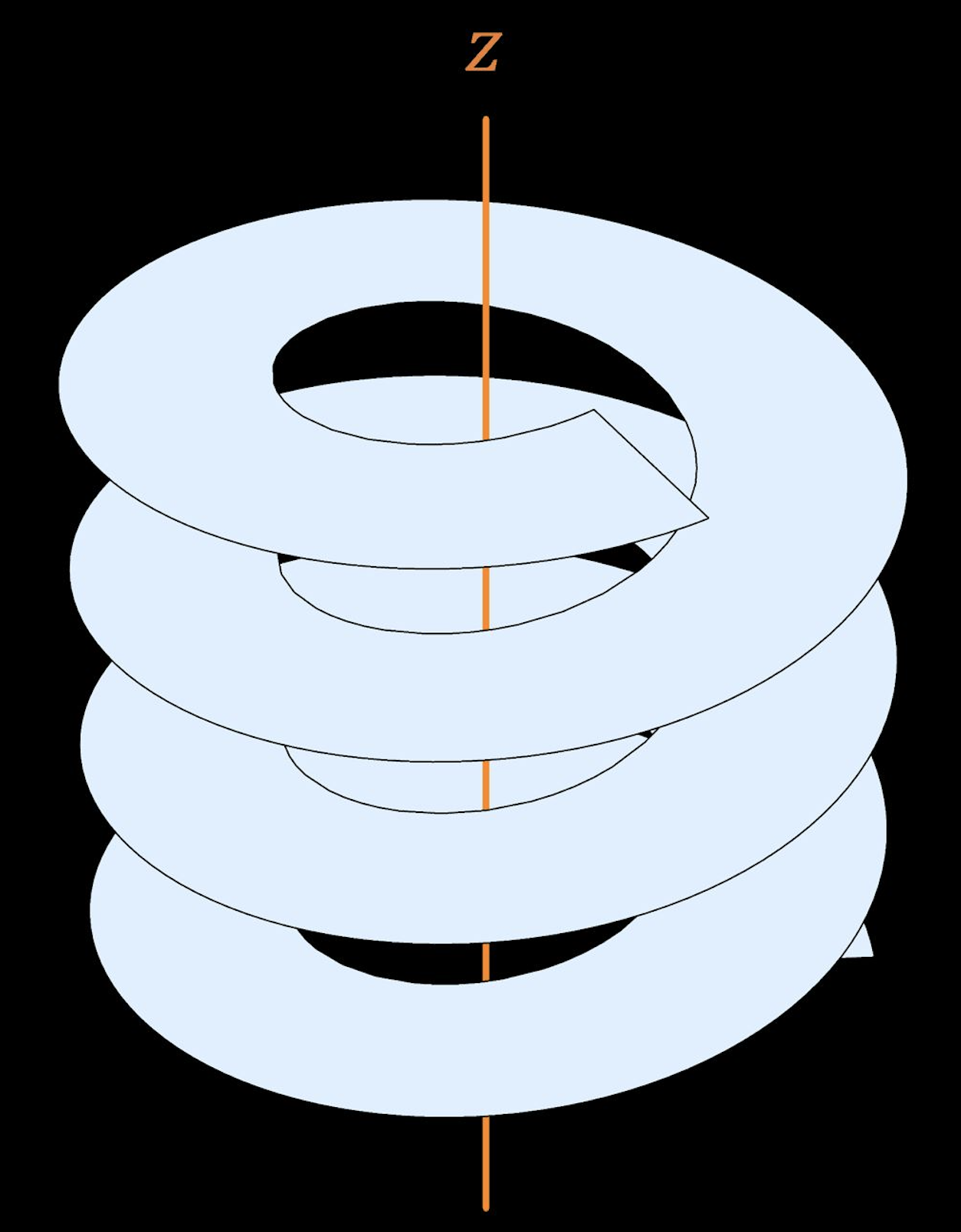
What does hydrodynamics look like when only a combined rotation-plus-translation is conserved? We work out the answer for helical fluids in 3D, finding new nondissipative coefficients, microscopic realisations via kinetic theory, and a natural connection to pinned cholesteric liquid crystals. The result is a hydrodynamic theory for systems whose symmetry is neither purely rotational nor purely translational, with transport phenomena that would be forbidden in ordinary fluids.

Paper

Terahertz Radiation from the Dyakonov-Shur Instability

Terahertz Radiation from the Dyakonov-Shur Instability of Hydrodynamic Electrons in a Corbino Geometry

Jack H. Farrell, Nicolas Grisouard, Thomas Scaffidi

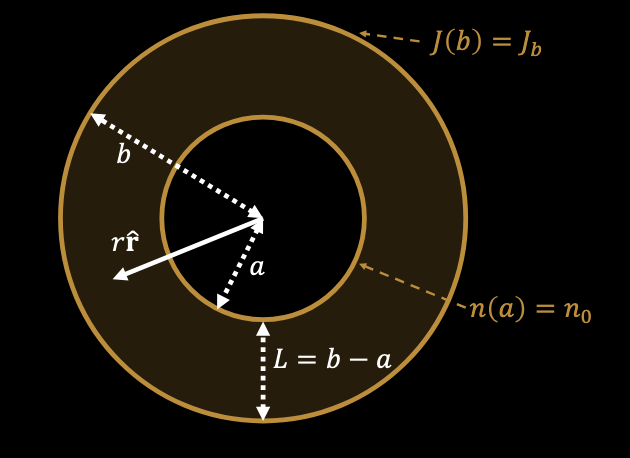
Hydrodynamic electrons in a Corbino disk go unstable above a critical drift velocity, producing self-sustained plasma oscillations. The Corbino geometry dramatically enhances the Dyakonov-Shur instability, making it a promising terahertz source—we work this out analytically and confirm it with full Navier-Stokes simulations.

Paper